Casual Kitchen Express
A complete food delivery platform for a Nigerian kitchen: customer, rider and kitchen Android apps, a serverless API with live updates, and a website, built and released in eight days on free plans.
Role: Product owner, designer and sole developer: planning, brand and UX design, all three apps, the API, the website, real-device testing and the releases. Built using an AI-assisted workflow (Claude Code).
Problem
A food delivery business is really several businesses that have to agree with each other second by second. Customers want to order in a few taps and see exactly where their food is. Riders need to carry orders efficiently without their phone dying halfway through a shift. The kitchen needs one place to see what's coming in, take walk-in orders at the counter, send riders out, manage the menu and staff, and account for every naira at the end of the day. Each group needs its own app, and all of them have to agree about the same order at the same moment.
Casual Kitchen Express (CKE) is a portfolio concept I designed so I could build all of that end to end: a home-style Nigerian kitchen in Ugbowo, Benin City, near the University of Benin, delivering from Uselu to Oluku Market under the slogan "Tastes like home. Arrives fast." I wrote the brand and business foundation first, and the setting brought real constraints with it: budget Android phones, unreliable and expensive mobile data, riders on long shifts in the sun, and streets where an address is often a landmark rather than a number.
There was also no budget. Everything had to run on free plans: a serverless API limited to about 10 ms of CPU per request, daily caps on requests and database queries, and no card on file anywhere, so a public demo could never generate a bill. It also had to be safe to show to anyone. Payments, refunds, deliveries and rider payouts are simulated, and no real card details are ever collected.
Goals
Customers should order in as few taps as possible on everyday Android phones, without creating an account until checkout, and see the order's progress and the rider's position live.
Riders should carry orders efficiently, up to three at once when they fit, without the app draining the battery or heating the phone over a long shift.
The kitchen and the office should run the whole day from one app on a tablet or phone: the order board, walk-ins at the counter, dispatch, the menu, staff, reports, rider pay and the daily cash-up, with each staff role seeing only what it needs.
The platform should cost nothing to run, be safe to demonstrate in public, and be documented and tested like a real product: every feature has an ID, every decision is written down, and every release is checked on real devices before it ships.
Solution
Casual Kitchen Express is three Android apps, one API and a promotional website, all in a single TypeScript monorepo and all open source under the MIT licence. The apps install free from GitHub Releases on Android 10 or newer.
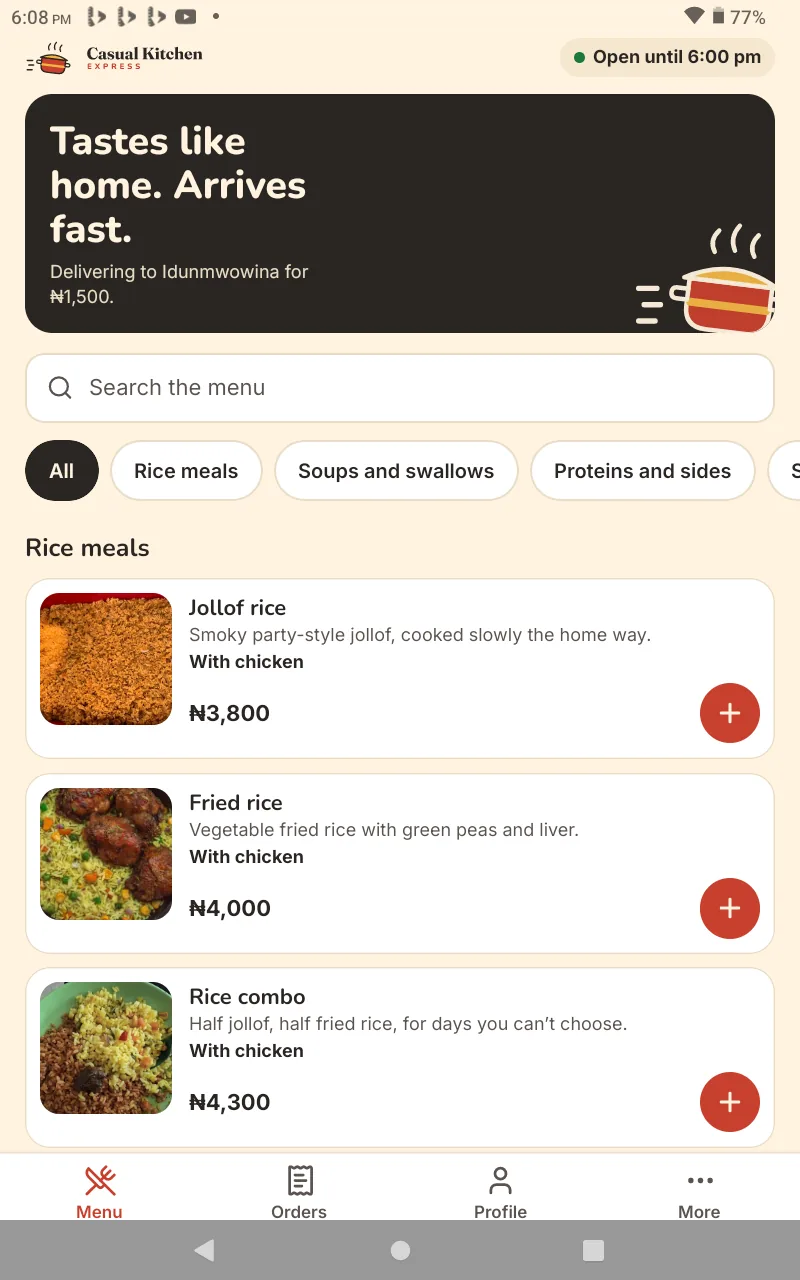
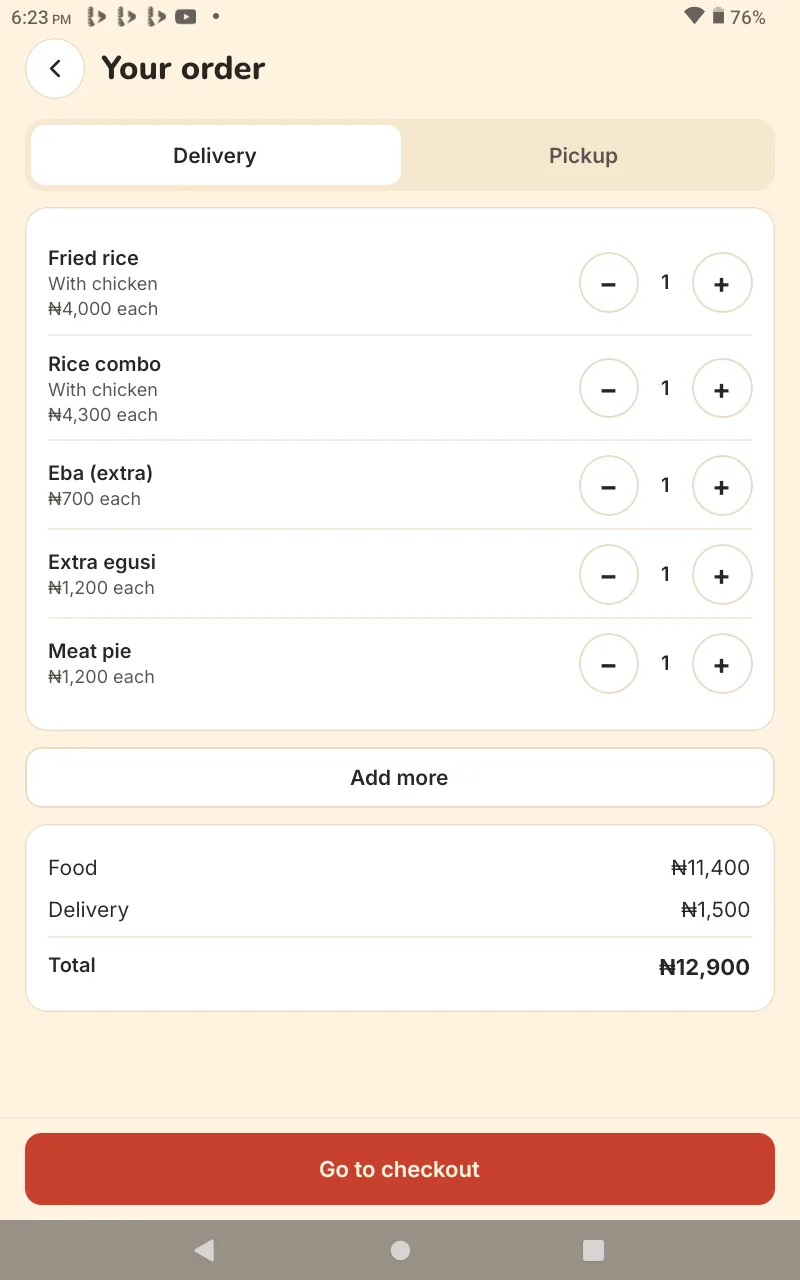
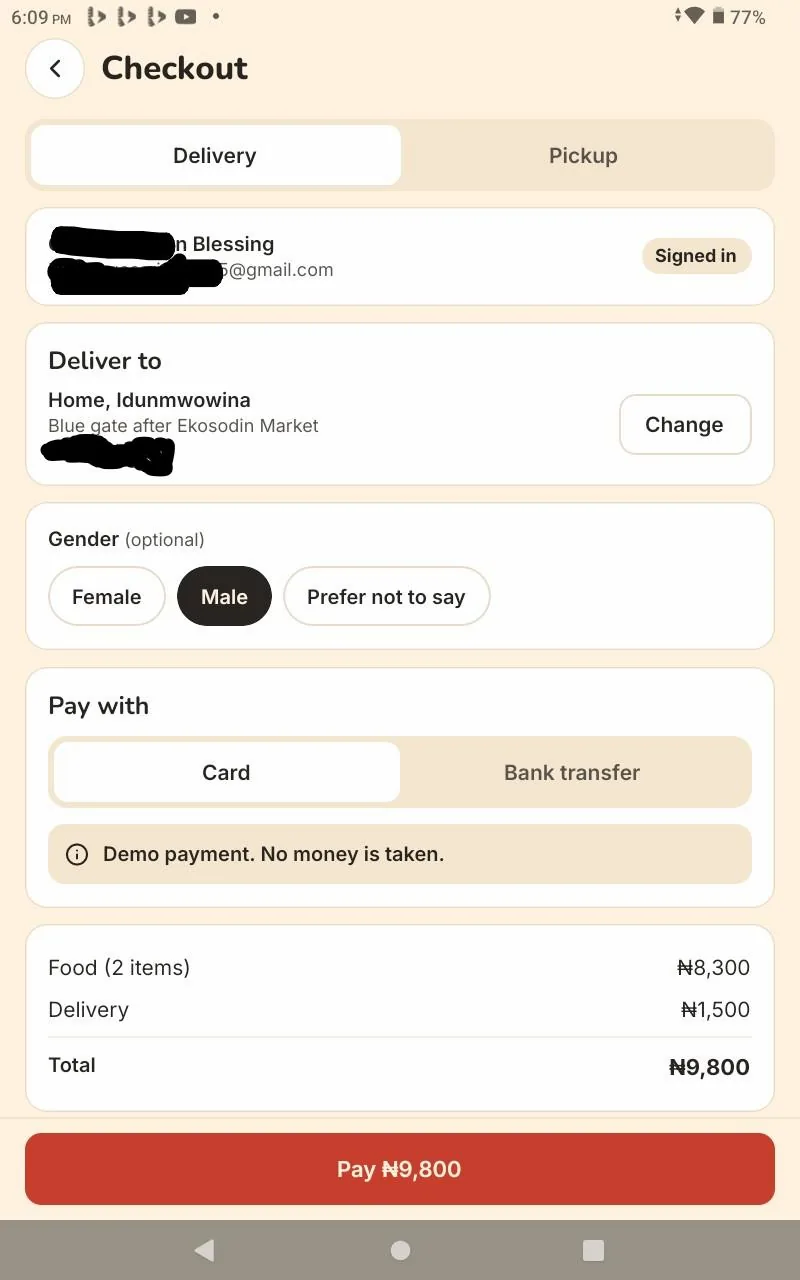
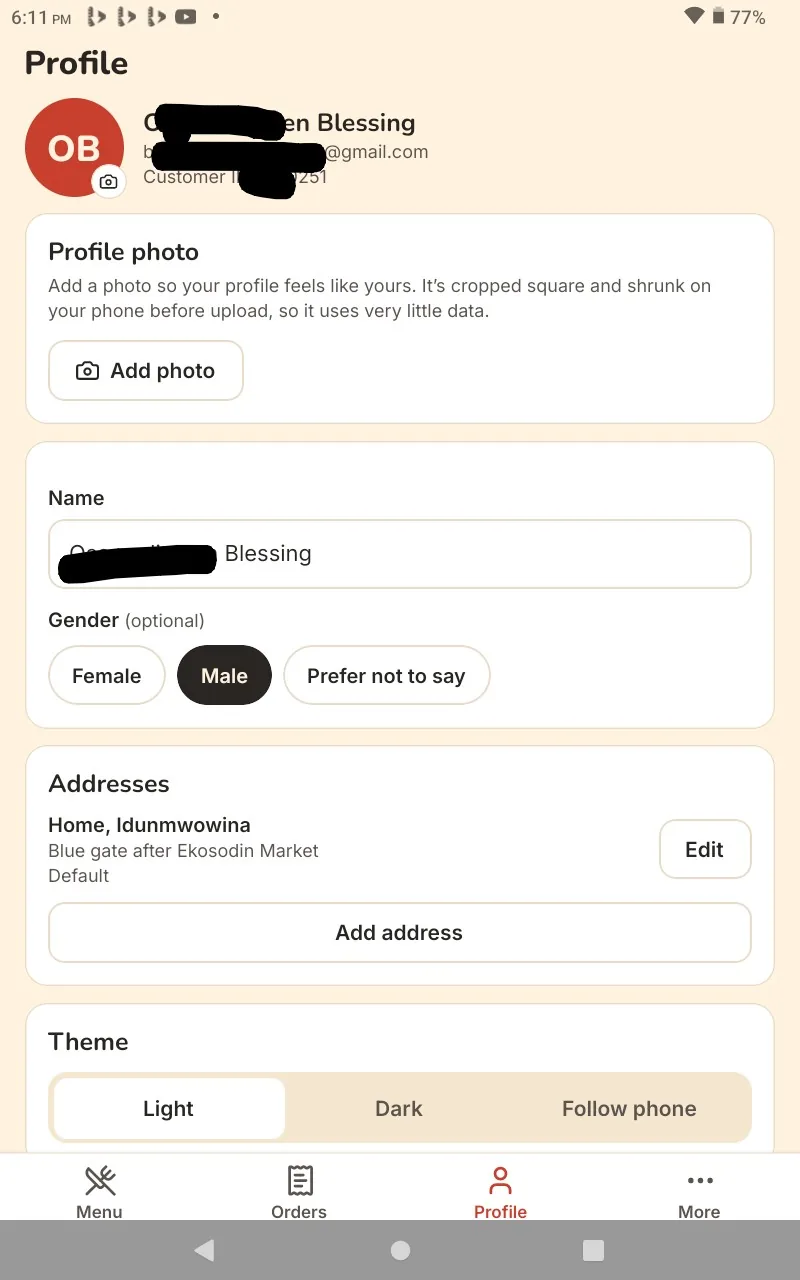
CKE, the customer app, lets anyone browse the menu without an account, where a daily soup of the day changes what the soup dishes include. Checkout is one screen, with Google sign-in only at the moment it's needed. Delivery addresses use a dropped pin, checked against a delivery boundary drawn from real map points. After a simulated payment, the customer follows the order through every stage (placed, cooking, ready, picked up, arriving, delivered) with push notifications at each step and a live map showing the kitchen, the address and the rider's marker once the food is picked up. A 4-digit delivery code closes the order, and a past order can be repeated in two taps.
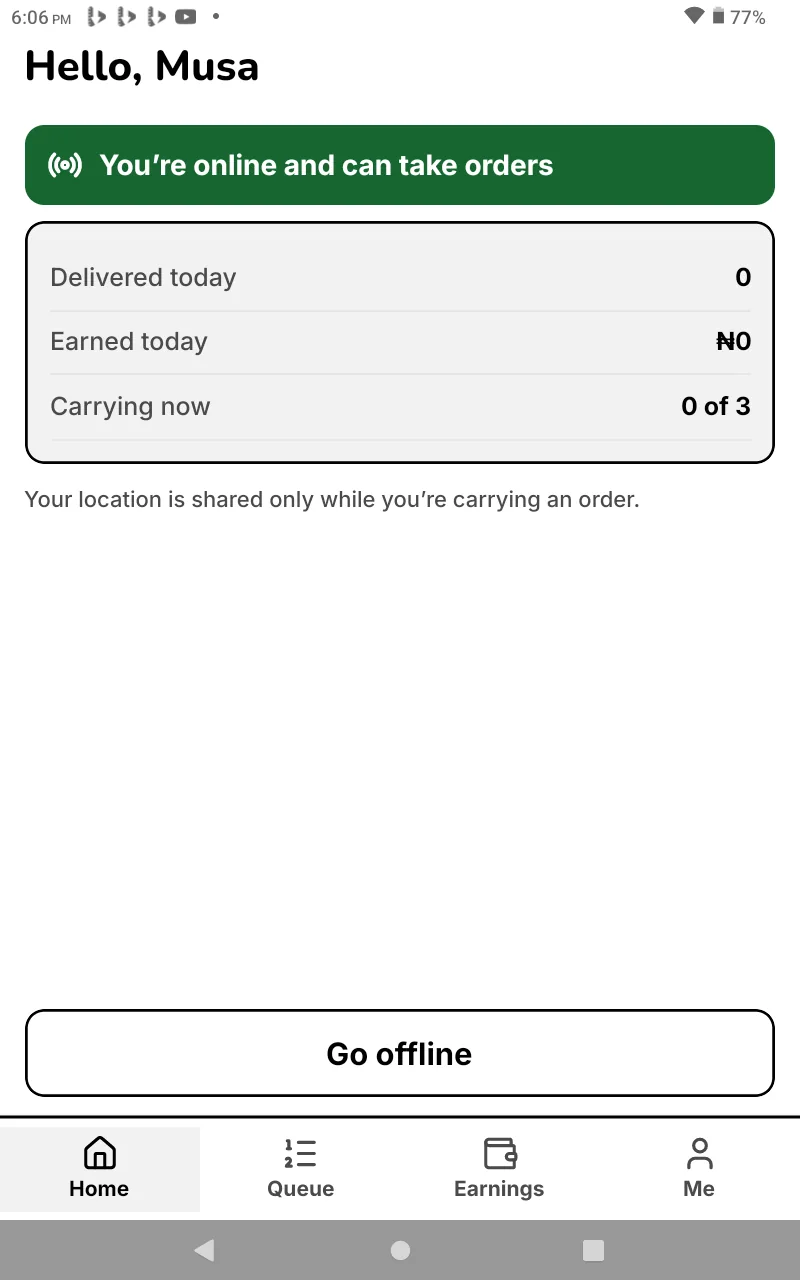
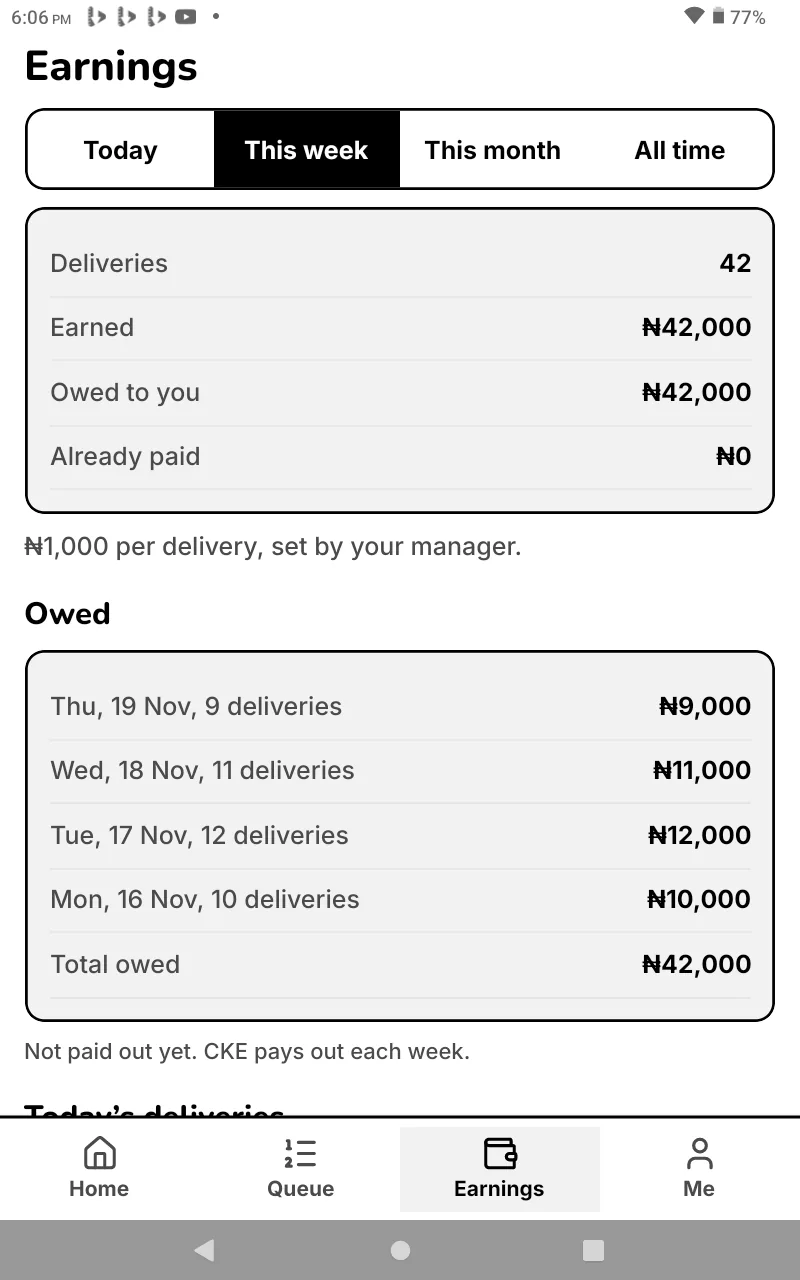
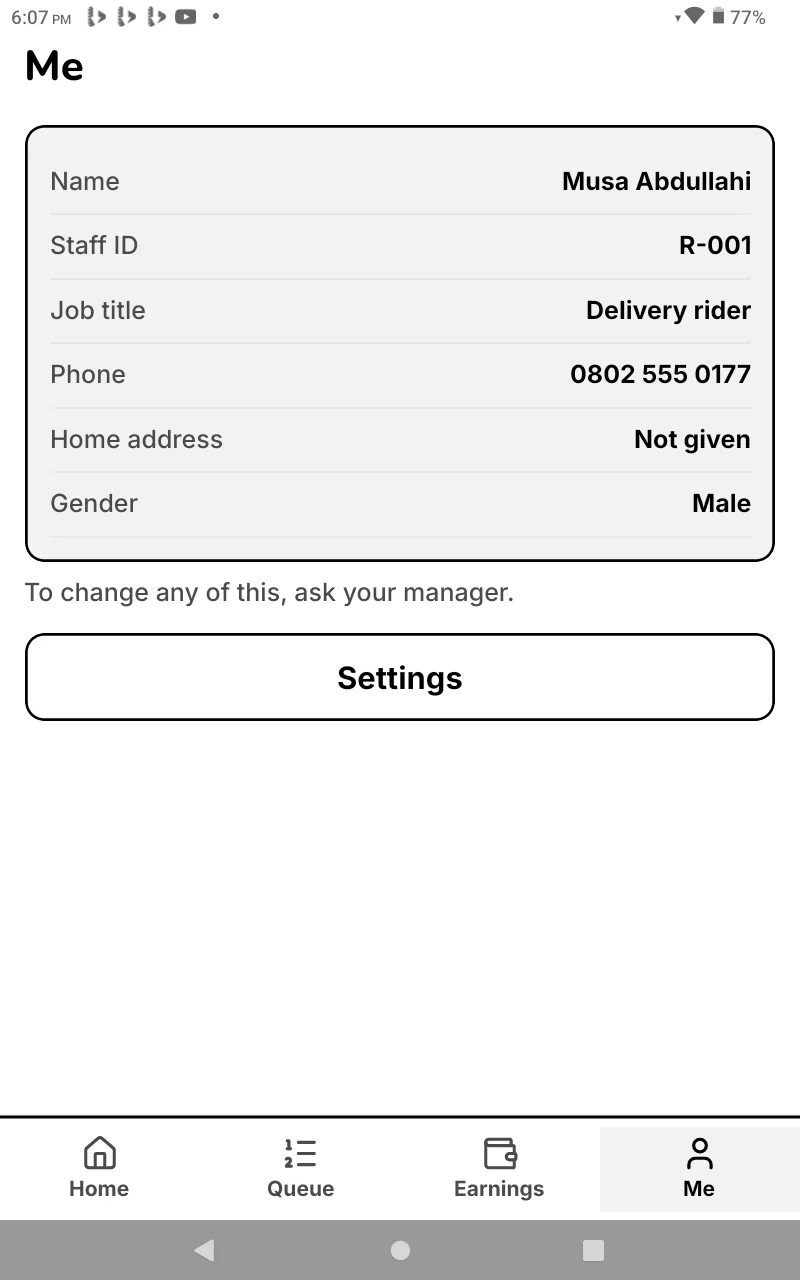
CKE Rider lets a rider go online and take orders from a shared queue, where the first rider to accept wins. A rider can carry up to three orders when their combined load fits a capacity budget. The app has no map of its own: it hands each address to the phone's navigation app, and shares its location only while carrying an order, as an Android foreground service with a visible "Delivery in progress" notification. A geofence about 300 metres from the door tells the customer the rider is arriving, and the rider confirms the delivery with the customer's code. An earnings screen shows deliveries, amounts owed and amounts paid.
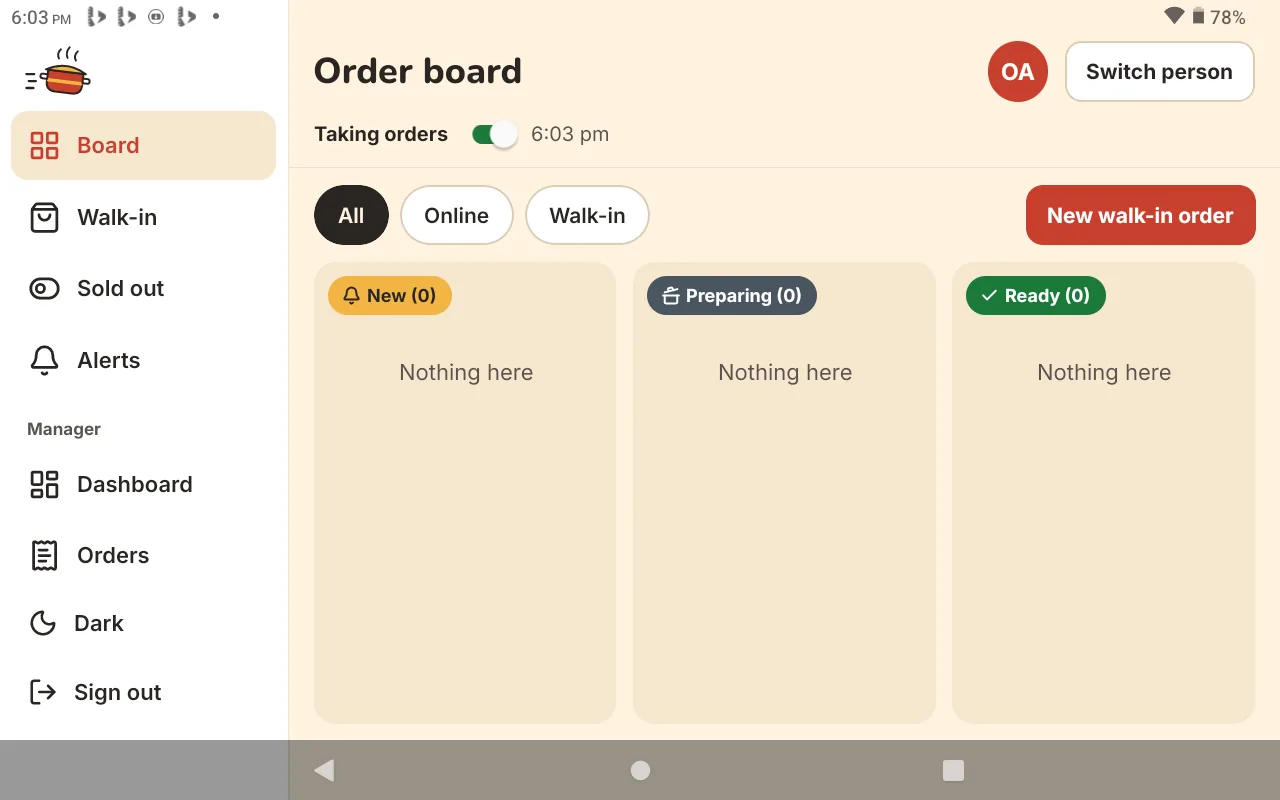
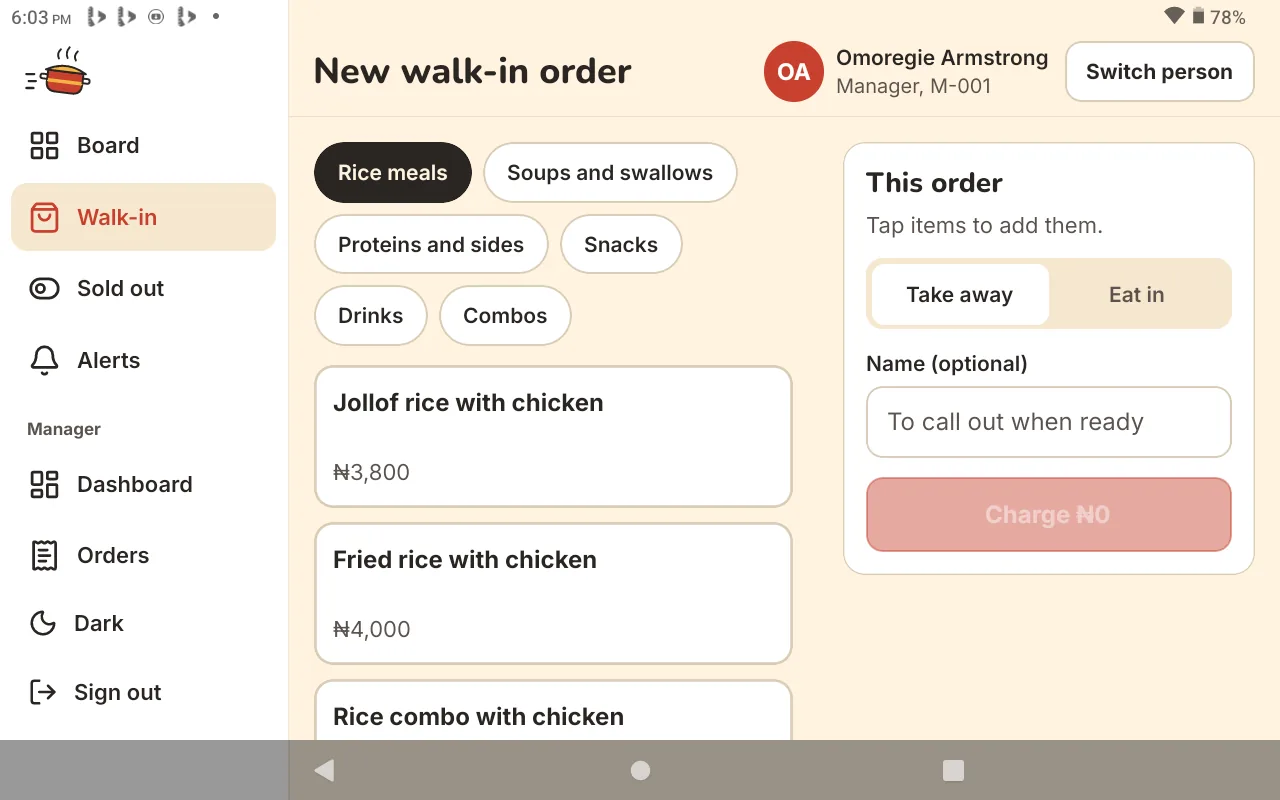
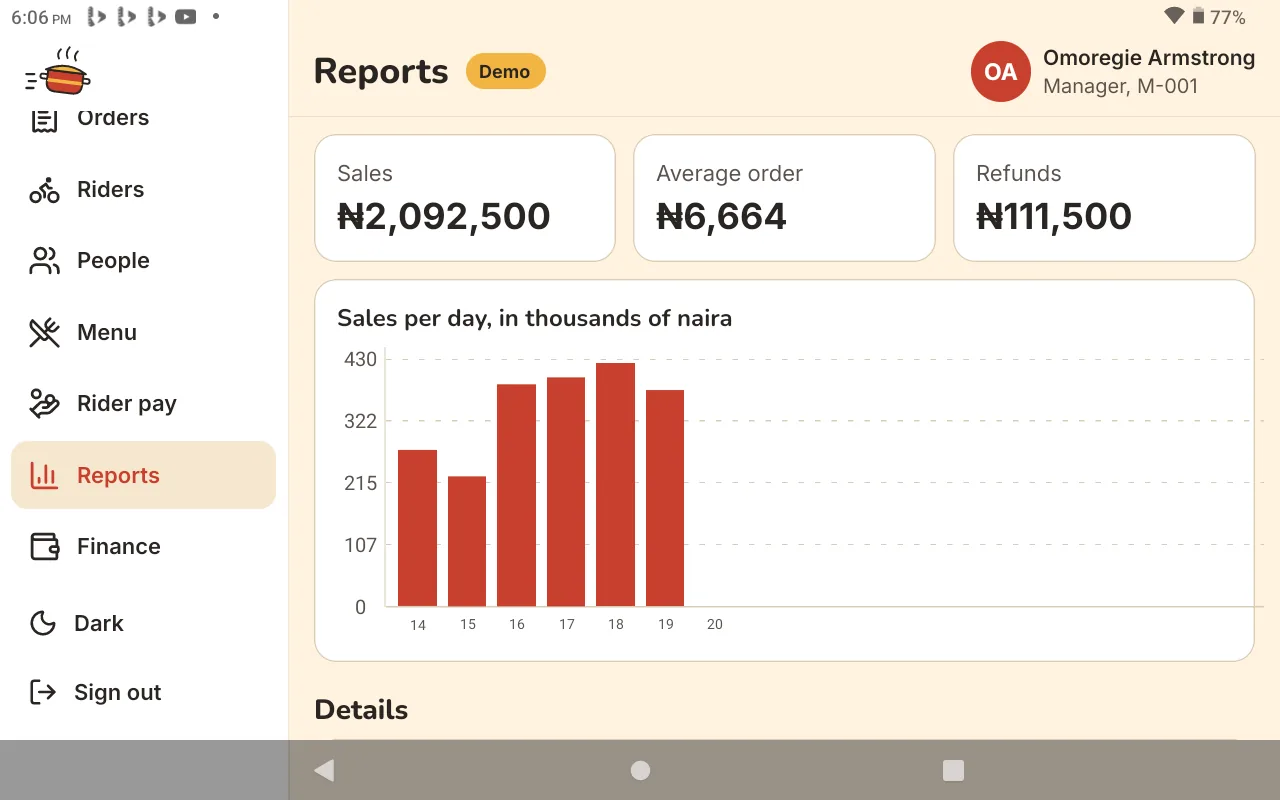
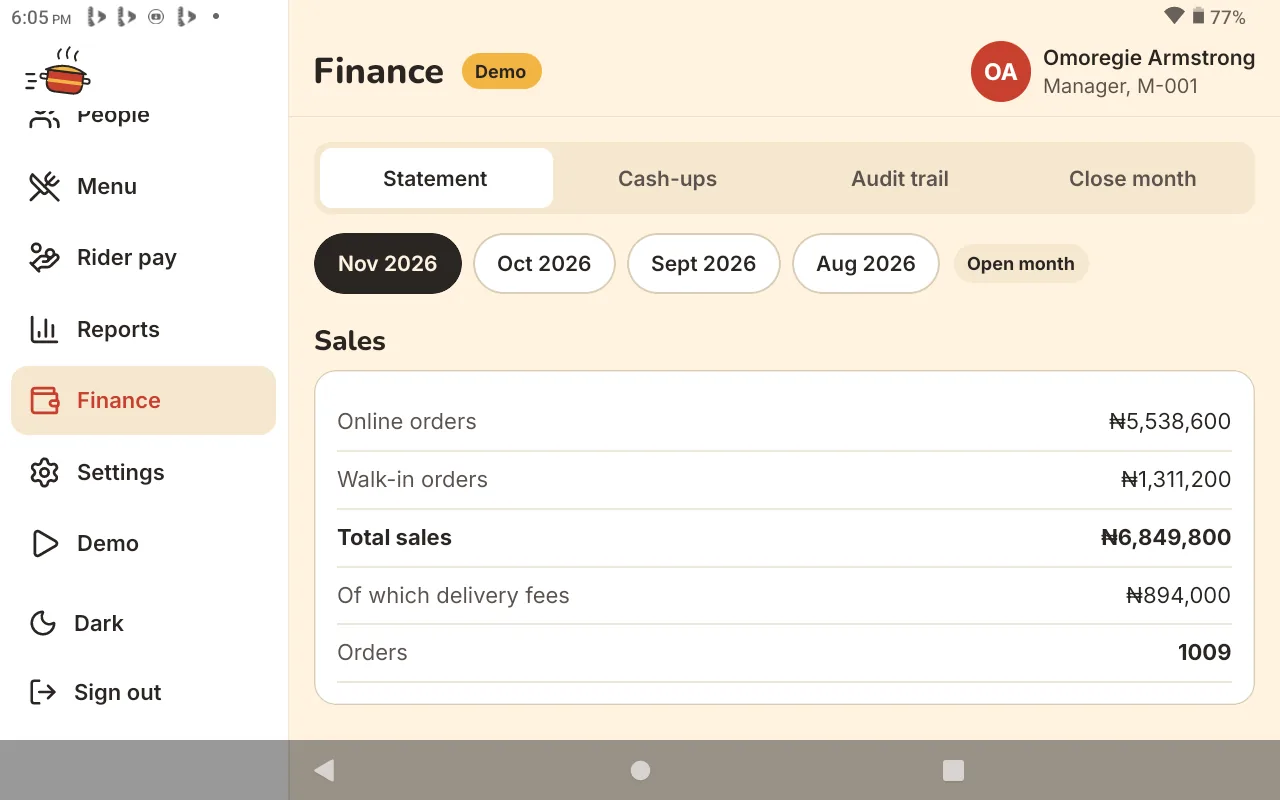
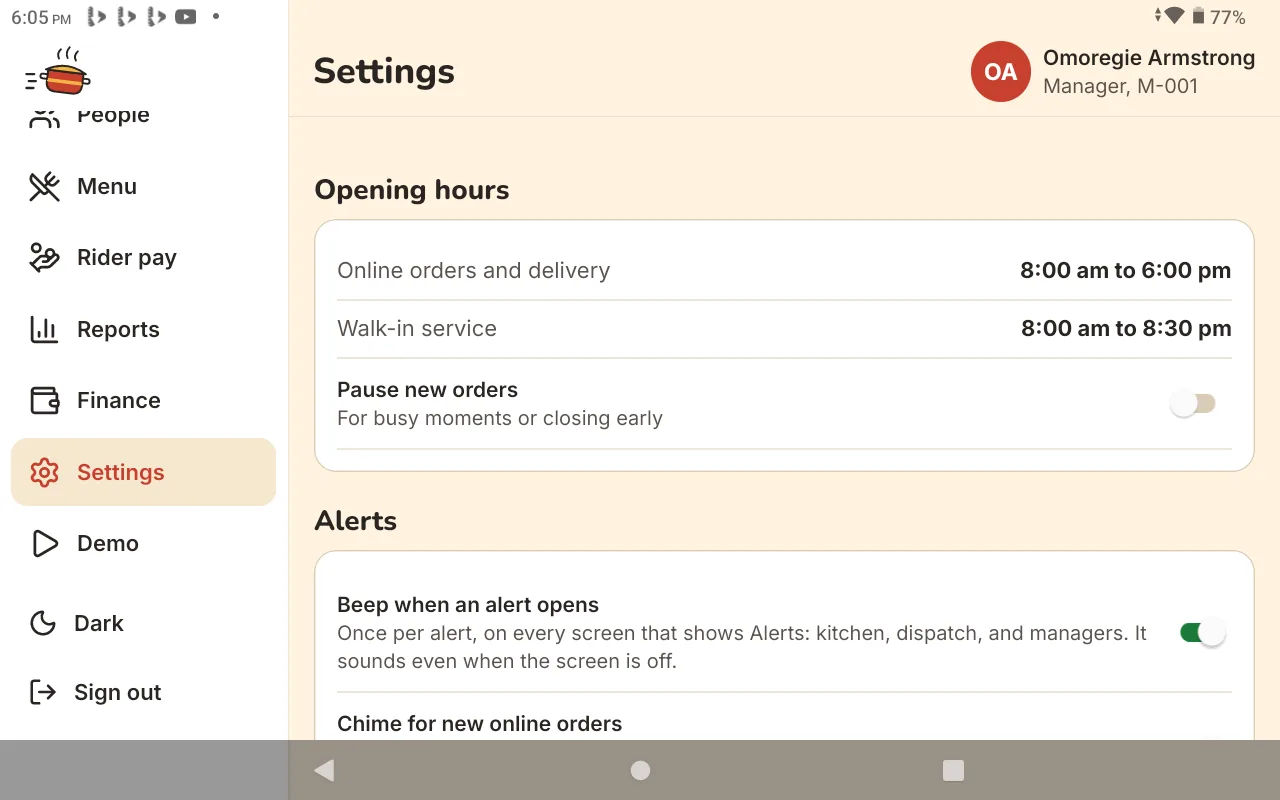
CKE Kitchen is the business app, for tablets and phones, with five staff roles: kitchen staff, dispatch officers, account officers, managers and the owner. The kitchen gets the order board with a new-order chime, walk-in orders paid in cash or online, sold-out switches and the soup of the day. Dispatch assigns riders and sees timed alerts for orders that wait too long. Managers get a dashboard, orders, riders, staff accounts and roles, the menu with photo upload and compression, sales, area, rider and refund reports, rider pay, Finance (the daily cash-up and the monthly close), settings for hours, capacity, tracking and the delivery boundary, a guided tour, and demo controls for practice orders and a full reset.
Behind all three sits one API of about 40 route groups on Cloudflare Workers, covering sign-in and roles, the menu, orders, refunds, riders, alerts, live updates, push notifications, photos, reports, finance and the demo tools. The website, on GitHub Pages, presents the brand, the menu, the delivery area, an FAQ, privacy pages and the customer app download, with structured data and light and dark themes.
Screenshots
CKE (customer app)
Browse, order and follow the food. On the test tablet, in portrait.
CKE Rider
Go online, take orders and track earnings. On the test tablet, in portrait.
CKE Kitchen (business app)
The manager's view on the test tablet, with demo data.
Highlights
- Planned, prototyped and built in eight days: clickable prototypes on 11 November 2026, release 1.0.0 on day 8, then 1.0.1 and 1.0.2 by 19 November. 129 feature IDs, about 35,000 lines of TypeScript, HTML and CSS, and 68 commits.
- Live updates with no polling: a Durable Object holds every app's WebSocket and sends each changed record once. Idle connections hibernate, and a reconnecting app catches up with one
GET /changes?since=Ncall. - Password hashing measured to fit Cloudflare's 10 ms CPU budget: PBKDF2 through the native Web Crypto API at 30,000 iterations (about 5 ms median on the project's own account), plus rate limiting.
- A rider app built for battery life: no map, balanced-accuracy location only while carrying an order, and a geofence for arrival. A two-hour delivery test used about 0.5% of the battery an hour, against a target of 10%.
- The delivery code is never stored. It's derived from the order with a keyed hash (HMAC-SHA-256), and only a hash of it is saved to check what the rider types.
- Tested on a budget tablet (Unisoc T310, 4 GB): no memory leaks across all three apps, 104 to 154 MB per app, 9 to 14% of one core in use and 0% in the background, all 60 colour pairs passing contrast, plus 45 API tests and 27 website tests.
- Every release ships three signed APKs with SHA-256 checksums, and the apps tell people when a new version is out.
Architecture
One API is the single source of truth, and the clients never talk to each other directly. The three apps reach a Hono API on Cloudflare Workers over HTTPS for requests and WebSockets for live updates. Behind the API, Neon Postgres holds the data (reached through Cloudflare Hyperdrive), a Durable Object called LiveHub holds every live connection, Workers KV stores menu and staff photos as WebP, and Expo's push service delivers notifications through Firebase Cloud Messaging. Better Auth runs inside the Worker, so sign-in needs no separate service.
Everything lives in one TypeScript monorepo (npm workspaces and Turborepo): the customer, rider and business apps, the API and the website, plus shared packages for types, validation schemas, a typed API client and brand tokens. Because the apps and the API share those packages, a change to an order's shape is type-checked in every app at once rather than discovered at runtime.
An order is always saved to the database first and pushed second. The kitchen also gets a push notification for each new order, so it's alerted even if its live connection dropped. Each status is pushed exactly once: the order remembers the last status it notified, so a retried request never repeats a notification.
Access control lives in the API, not in database rules. There are six roles (customer, rider, kitchen staff, dispatch officer, account officer and manager), and every endpoint checks the caller's role and ownership of the data, because hiding a screen in an app isn't protection. Money actions, account changes, manual overrides and taps on a customer's phone number are all written to an audit log.
Outside the API, the website is static on GitHub Pages, signed APKs are published on GitHub Releases, and GitHub Actions both deploys the website and re-seeds the online demo database when a manager asks for a reset from the business app.
Frontend
All three apps are React Native 0.88 on Expo SDK 58, with file-based routes in Expo Router and server data in TanStack Query. Each kind of data gets its own freshness time, so stable data such as the menu isn't fetched again just because a screen reopens, and the apps refetch when they reconnect or return to the foreground, never on a timer. Custom Expo config plugins handle release signing from keys kept outside the repository, and the processor targets (64-bit ARM for development, plus 32-bit ARM for release).
The customer app is built around fewest taps. The menu works without an account, and Google sign-in happens only at checkout, through Better Auth's browser flow returning to the app by its link scheme. The tracking map uses MapLibre with OpenFreeMap tiles, which need no account, key or card. Instead of an address search, which would mean geocoding costs and works poorly where street addresses are unreliable, the customer picks a neighbourhood in the delivery range, drops a pin and adds a landmark. The API then checks the pin against a 14-corner boundary polygon.
The rider app is deliberately plain: high-contrast screens readable in sunlight, no images or animations, and no map. Location runs at balanced accuracy, about every 45 seconds and only after the rider has moved about 100 metres, slowing further on battery saver. The screen stays awake only on the pickup and code-entry screens. When the rider switches to their navigation app, the CKE app keeps sharing through a foreground service and stops when the last delivery is done.
The business app adapts to tablets and phones. Its side menu shows each staff role only its own screens; the board chimes for new orders; the walk-in screen works out change for cash payments; and Reports and Finance draw their charts and statements from the API. A guided tour walks managers through every screen. On narrow phones the top bar splits into two rows and hides the clock at 425 dp or less, while tablets keep the single-row layout.
Photos are compressed on the phone before upload in every app: cropped to a fixed ratio, resized to at most 1200 px for menu images or 512 px for profile photos, converted to WebP at about quality 78, and stripped of location and camera data, with a preview of the space saved. Every app has light and dark themes, and all 60 text and colour pairs were measured to pass contrast. Each app checks GitHub's latest release once after opening and offers the update when there is one.
Backend
The API is Hono on Cloudflare Workers, with about 40 route groups: sign-in and roles, the menu and soups, checkout and orders, cancellations and refunds, riders and the queue, alerts, settings, addresses, live updates, push, photos, reports, finance and the demo tools. It runs at Cloudflare's edge with no server to manage, inside the free plan's limits.
Those limits shaped the code. With about 10 ms of CPU per request, reports and aggregations run as SQL inside Postgres rather than in the Worker, images are never processed on the server, and handlers stay light. Workers also allow 100,000 requests a day, so I estimated a busy demo day (about 200 orders at about 40 requests each, plus browsing and rider updates) at around 10,000 requests and 30,000 database queries, comfortably inside the limits.
Business rules live on the server. Checkout prices every order from the current menu, never from what the app sends, and checks the opening hours, the pause switch and whether the address is inside the delivery boundary. Each kitchen step includes the expected status in the update itself, so two taps at once can't both succeed. When two riders accept the same order, the order row is locked first, so one wins and the other is told it's gone. A timed check runs every minute while orders are open and raises alerts for orders waiting too long. Refunds can be full or partial (up to 99% of what was paid), and customers who cancel repeatedly within seven days can only request cancellations, which a dispatcher or manager decides.
Data freshness was designed to keep calls low. One start-up call, GET /bootstrap, returns the menu and customer-facing settings with a catalog version as an ETag, so an unchanged menu comes back as a tiny 304. Orders, alerts and rider states share one change counter, so a reconnecting app asks for everything since the last number it saw in a single call. Writes return the updated record, so no follow-up read is needed, and long lists are paged 150 at a time.
To make the demo believable, seed scripts create three months of order history (about 4,266 orders), a live simulator places orders, and managers can create practice orders or reset all demo data from the business app. The online reset needs the seed scripts, which can't run inside a Worker, so the API starts a GitHub Actions workflow using a fine-grained token limited to that one repository. A reset takes about two minutes.
Database
Neon Postgres, chosen after comparing it with Supabase and Firebase on their November 2026 free plans. Orders and money are relational data, and manager reports need grouping, joins and date ranges, which SQL does natively. Firebase's per-operation billing and the billing account its file storage now requires ruled it out. Supabase would have bundled auth and real-time, but its free projects pause after a week of inactivity. Neon is only the database, so authentication, real-time and storage were chosen separately.
The schema is written in TypeScript with Drizzle ORM, and Better Auth's user and session tables live in the same schema as the app's own. The project has 10 versioned SQL migrations, all kept in Git. The Worker connects through Cloudflare Hyperdrive for pooled connections from the edge. Hyperdrive caches query results by default, and that caching was turned off so a live order is never served stale.
Every order records its channel. Online orders are numbered continuously (O-0001, O-0002 and so on), while walk-in numbers restart at W-001 each day, because they're called out at the counter. Order lines keep the dish name and price at the time of the order, and every status change is stored with who made it and when, which makes the timing reports possible: preparation time, wait for a rider and delivery time. Payments, refunds, rider payouts, daily cash-ups and monthly closes all have their own tables, a closed month can't be edited, and the audit log keeps before and after values for every money and setting change.
Privacy was designed in rather than added. The rider's position is kept only as the last point and only while an order is on the way, and it's deleted at the last delivery. The delivery code is stored only as a hash, and staff passwords are hashed with PBKDF2 and rate-limited. Staff accounts are deactivated, never deleted, so order history and reports stay accurate. Seeded customers and staff are fake, with emails on a reserved example domain, so nothing can ever reach a real person. Photos live in Workers KV, with only their references in the database.
Challenges
Hashing passwords inside a 10 ms CPU budget. Riders and other staff sign in with usernames and passwords, but bcrypt and scrypt take 70 ms or more, far over the Workers free plan's roughly 10 ms per request. PBKDF2 through the native Web Crypto API was the workable option, so I measured it on the project's own Cloudflare account: 20,000 iterations took a median of 4 ms, 30,000 took 5 ms, 50,000 took 9.5 ms, and 100,000 reached 34 ms. I chose 30,000, which leaves room under the limit for the rest of the sign-in request, and added rate limiting through a Durable Object. That's weaker than the usual recommendation, which is acceptable here because these accounts guard only simulated data, and the trade-off is written down.
The business app slowed the tablet down. After a tour of the app, the budget tablet was nearly out of memory, with about 80 MB free and the business app at 735 MB. The cause was navigation: every tap on the side menu added a new screen on top of the stack, so every screen visited stayed alive with its photos and charts. A small navigation helper now replaces the screen instead of stacking it. Memory growth per tour fell from 98 MB to 11 MB once warm. The customer and rider apps had a smaller version of the same problem, where returning to the tabs opened a whole new set of tabs (54 MB and 14 back presses after six trips in one case), and both were fixed the same day. Later checks on the release builds found no leaks.
The customer's map froze for the last 300 metres. An end-to-end test of one order through all three apps showed that the rider app stopped sending its position once an order was "arriving", so the customer's map stood still at the most important moment. Sharing now continues until the last delivery, and only the arrival geofences skip arriving orders. Fixed in release 1.0.1, along with a sign-in screen where the keyboard covered the button and its error message.
The top bar didn't fit on a narrow phone. On a Samsung Galaxy A07, about 384 dp wide, the business app's top bar pushed the profile photo and "Switch person" off the screen, and Android's navigation buttons covered the bottom of the content. On phones the bar now uses two rows, the clock is hidden only at 425 dp or narrower, and content stops above the navigation buttons, while tablets are unchanged. Fixed in release 1.0.2.
Testing battery life without leaving home. The two-hour rider battery test ran on the tablet with Android test locations moved along a route at 30 km/h by a script, which also sampled the battery every minute and checked that each position reached the server. At the end I moved the location to the door to confirm the arrival alert, and entered the code to confirm the delivery.
Release builds on a 2014 laptop, through a power cut. A release build takes 30 to 60 minutes per app on this machine, and a power cut stopped one mid-build. The database came back intact (all 4,274 orders at the time), and I made the release script resumable: it keeps any APK already built from the same code, so a rerun builds only what's missing. Development builds target only 64-bit ARM to keep everyday builds shorter.
Google couldn't fetch the sitemap. Search Console reported "Couldn't fetch" for the sitemap on GitHub Pages, even though the file returned 200 and Bing read it fine. Research showed this is a widely reported github.io problem that doesn't stop indexing, so I requested indexing for each page by hand and improved the titles, descriptions and structured data for local search.
Smaller walls: photos moved from R2 to Workers KV so storage needs no card on file; Wrangler needed Node's network family timeout raised before it could reach Cloudflare from this laptop; four npm audit advisories in laptop-only build tools had no safe upgrade yet, so they were recorded and left for a later version; and a GitGuardian alert led to a check of the whole Git history, which found no real secret, only values that are public on purpose, such as the shared demo staff password.
Technical Decisions
A TypeScript monorepo, so the apps and the API share types, validation schemas and one API client. Expo and React Native, for native Android apps from one language, with config plugins for signing and processor targets. Hono on Cloudflare Workers for a fast, free, global API with no server to manage. It replaced an earlier Fastify plan that suited a Node server but not Workers, and because Hono also runs on Node, the API could move hosts later without a rewrite.
Durable Objects for live updates, because WebSockets with hibernation mean no polling and idle connections cost almost nothing against the daily request limit. Neon Postgres through Hyperdrive with Drizzle, for a real relational database for orders and money, pooled connections from the edge, and migrations in Git.
Better Auth for one sign-in system with roles: Google for customers and managers, usernames and passwords for the other staff. Google sign-in also means no forgot-password flow, so the platform sends no email at all. That matters because free email services need a verified domain to reach other people, and this project has none. Staff passwords are reset by a manager instead.
No map in the rider app, because maps and high-accuracy GPS are among the most battery-hungry things a phone does, and riders already use a navigation app. MapLibre with OpenFreeMap for the customer's map, because it needs no account, key or card, so a public demo can't generate a bill. Google Maps would be the choice if richer place search ever mattered more than cost.
APKs on GitHub Releases instead of the Play Store: no store fees or review delays, a check for the latest release in each app, and SHA-256 checksums for anyone who wants to verify a download. Payments, refunds and payouts are simulated throughout, with real statuses, rules and records but no provider, so no card details exist anywhere in the system.
Written decisions before code. An architecture document gives every feature an ID (CUS, RID, KIT, MGR, DSP, ACC and WEB), marks each decision as Proposal or Decided, and records the reasons. A design document and clickable HTML prototypes of every screen came before the apps, and a dated progress log kept the build consistent across many sessions.
Results
Release 1.0.0 shipped on 18 November 2026, followed by 1.0.1 the same day (the frozen-map and keyboard fixes) and 1.0.2 on 19 November (the narrow-phone top bar). Each release has three signed APKs and SHA-256 checksums, and an update installs over the previous version without signing anyone out. The update notice was verified on the tablet: every 1.0.1 app announced 1.0.2.
Every release was tested on real devices, a budget tablet (Unisoc T310, 4 GB of memory, Android 12) and a Samsung Galaxy A07. On release 1.0.1, about 40 minutes of tapping through every screen of all three apps showed no memory leaks, with memory levelling off at 104 to 154 MB per app. The apps used 9 to 14% of one processor core in use and 0% in the background, screens drew in 12 to 16 ms, and taps responded well within 100 ms. Release 1.0.2 was checked again with the same results.
An end-to-end test took one order through all three apps: placed and paid, acknowledged and cooked, accepted and picked up, followed live on the map, refused once with a wrong code, and delivered with the right one, with every push notification arriving. In the two-hour rider battery test, the tablet went from 100% to 99% with the screen off, about 0.5% an hour for the whole device, and ended cooler than it started. The rider app itself used about 1 mAh an hour. The movement was simulated over Wi-Fi, so a real phone on a real shift will use more, an estimated 1 to 2% an hour, still far under the 10% target.
The codebase has 45 API tests running against a real Postgres database and 27 website tests in Playwright, all passing. The API's health check is live, and the website is verified in Google Search Console and Bing Webmaster Tools. The platform is complete and no new features are planned. The remaining upkeep is timing the cold start over mobile data on a real phone, re-checking the build-tool advisories before any future release, and following up search indexing.
Lessons Learned
Writing decisions down pays off. Feature IDs, decisions marked Proposal or Decided, and a dated progress log kept a build this size consistent across many sessions, and made every change traceable back to why it was made.
Free plans shape the architecture as much as the features do. The CPU limit decided how passwords are hashed, the request limit decided how live updates work, and storage rules decided where photos live. Knowing the limits before choosing the tools saved rewrites later.
Test on the cheapest devices first. A budget tablet and a narrow phone found real problems that a fast phone would have hidden: memory build-up, a frozen map and an overflowing top bar.
Measure, don't guess. Hashing time, memory, CPU, frame times and battery drain were all measured before being called good enough. Several of those measurements changed a decision, the hashing iterations most clearly.
Related Writing
The Navigation Bug That Ate 735 MB
My kitchen tablet app slowed to a crawl at 735 MB. The cause wasn't a heavy screen but one navigation call that stacked every screen ever visited. How I measured it, fixed it in all three apps, and proved the fix.
What Free Plans Decided: Building a Delivery Platform for ₦0 a Month
Three Android apps, an API, a database, and a website, all on free plans. The ₦0 rule shaped nearly every decision, from password hashing to where the photos live. Here's what free plans decided, and what it cost.
Hashing Passwords in 10 ms of CPU
Cloudflare Workers' free plan gives each request about 10 ms of CPU, and a normal password hash takes several times that. How I measured PBKDF2 on my own account, why I chose 30,000 iterations, and what that trade-off leaves weaker.
Live Updates Without Polling
Live order tracking, a kitchen board, and a rider queue, with no polling at all. How one Durable Object, a single change number, and a few careful rules keep three apps in sync on patchy mobile networks and a free plan.
Casual Kitchen Express is a portfolio concept: the brand, menu and business were designed for this project. Payments, refunds, deliveries and rider payouts are simulated; no real money moves and no card details are collected. The code is MIT-licensed; the CKE name and logo are not part of that grant. Menu photo credits are in the project's repository.